
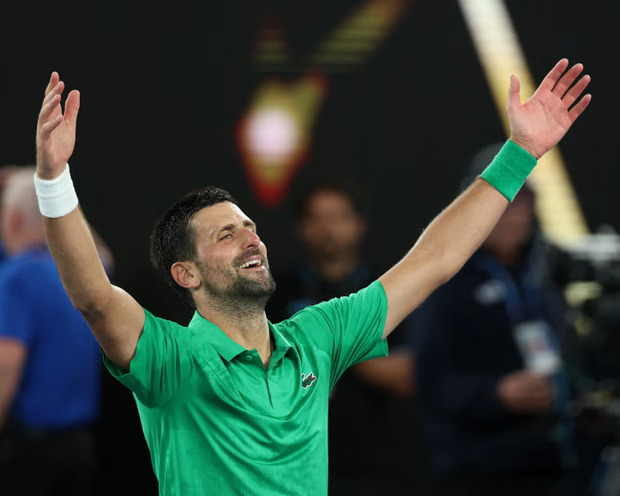
At 1:33am in Melbourne, Novak Djokovic lay flat on the blue court of Rod Laver Arena, arms raised, eyes fixed on the sky. This was not a celebration born of routine greatness. This was disbelief. At 38 years old, Djokovic had just produced one of the most extraordinary wins of his career—outlasting and outplaying Jannik Sinner in a four-hour-and-nine-minute Australian Open semi-final that felt like a final in everything but name.
The Upset That Didn’t Feel Possible
Coming into the match, the odds were stacked firmly against Djokovic. Sinner, the two-time defending champion and second seed, had beaten him in their last five encounters and represented the very future of men’s tennis—powerful, relentless, and seemingly tireless. Djokovic, by contrast, had arrived in the semi-finals surrounded by doubt. He hadn’t completed a full match since the third round due to opponents retiring, and earlier in the tournament he had been thoroughly outplayed by Lorenzo Musetti before injury ended that match prematurely.
Yet none of that mattered once the clock ticked past midnight.
After dropping the first set 6–3, Djokovic clawed his way back, trading momentum for momentum in a brutal five-set battle:
3–6, 6–3, 4–6, 6–4, 6–4.
It was not just a victory—it was a statement against time itself.
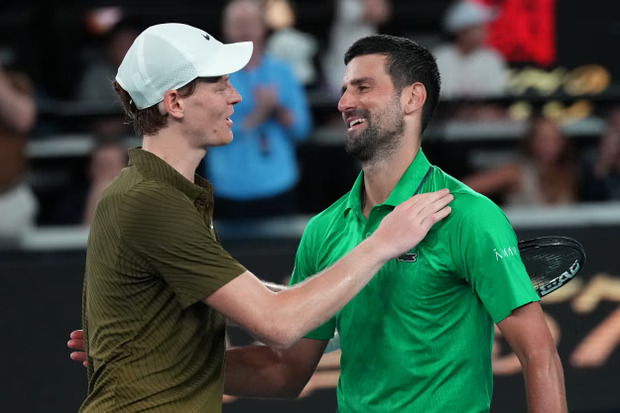
Longevity Like the Sport Has Never Seen
Djokovic is now the oldest man in the Open Era to reach the Australian Open final, extending his own records with an 11th Melbourne final appearance and a 38th Grand Slam final overall. No male player has ever shown this level of longevity while still competing—and winning—against the very best in the world.
This wasn’t a match won through experience alone. Sinner blasted 72 winners, served 26 aces, and applied relentless pressure. Djokovic, however, absorbed it all—saving 16 of 18 break points, including all eight he faced in the final set. When it mattered most, his serve became untouchable and his aggression fearless.
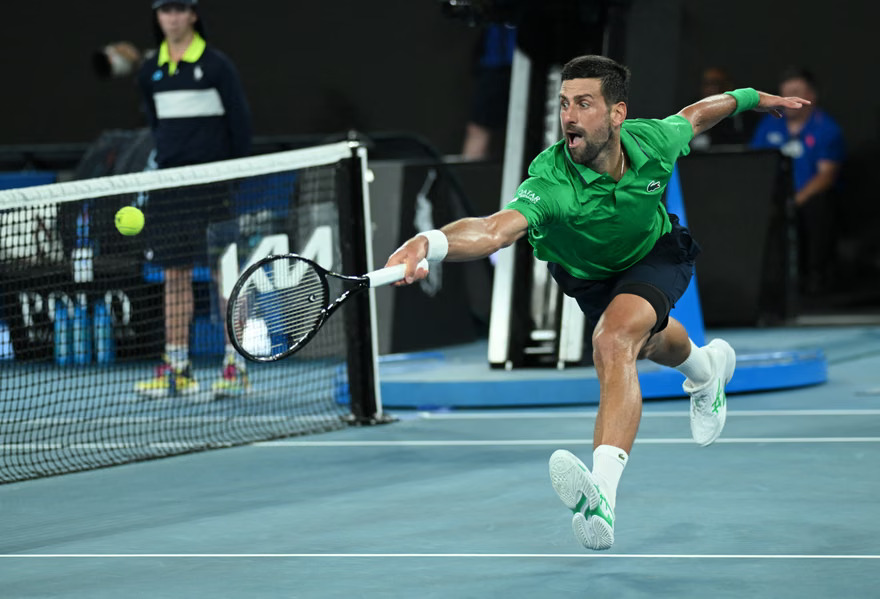
Against arguably the cleanest ball-striker on tour, Djokovic refused to retreat. He stood on the baseline, took the ball early, redirected pace with surgical precision, and trusted his movement—still astonishing at 38—to carry him through.
A Champion’s Mindset at 2am
Emotion poured out of Djokovic after the match. He spoke openly about the intensity, the memories of his six-hour 2012 final against Rafael Nadal, and the sheer improbability of what he had just achieved.
“Honestly,” he said, “it feels like winning the title tonight already.”
And it’s easy to understand why. Last year, Djokovic’s body failed him in every Grand Slam semi-final. The level was still there—but the legs weren’t. This time, with fresher legs and one clear opportunity, he refused to let history pass him by.
The Final We’ve Been Waiting For
Waiting for him in the final is Carlos Alcaraz, the world No. 1 and the embodiment of tennis’s next era. The matchup couldn’t be more symbolic: the greatest veteran the sport has ever known versus a 22-year-old chasing a career Grand Slam.
Djokovic is now pursuing a record-breaking 25th Grand Slam title, while Alcaraz aims to become the youngest man to complete the set. Experience versus explosiveness. Endurance versus youth.
Djokovic joked afterward that as an “old man,” he would have preferred an earlier start. But if this semi-final proved anything, it’s that when the lights shine brightest—no matter how late the hour—Novak Djokovic remains tennis’s ultimate survivor.
Final Thoughts
What makes this victory so special isn’t just the scoreline or the records. It’s the context. The doubt. The age. The opponent. And the time on the clock.
At 1:33am, Novak Djokovic didn’t just reach another Australian Open final.
He reminded the tennis world that greatness doesn’t expire—it adapts.